THE NEW PAYMENT RAILS · ISSUE #7
Stablecoins are moving into the funding layer of B2B payments
Why the latest moves from Visa and Mastercard matter less as “crypto payments” than as a redesign of how businesses fund, settle and move money across borders.
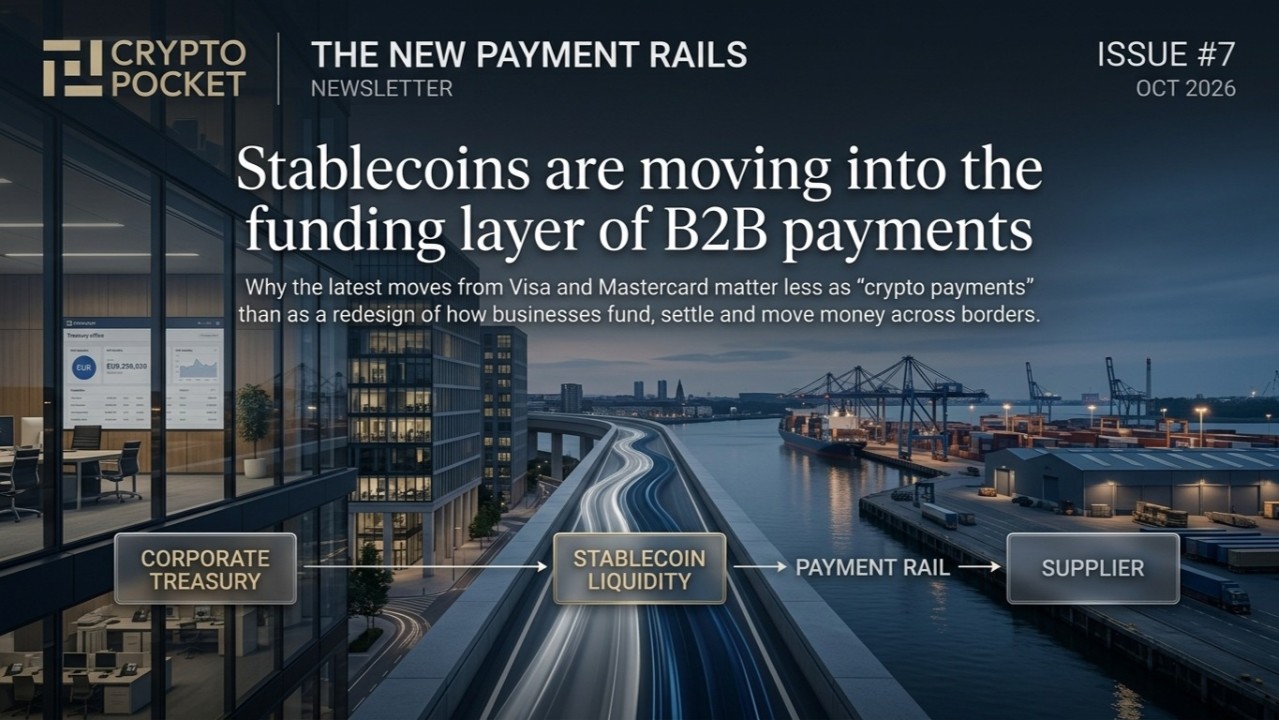
Stablecoins are moving into the funding layer of B2B payments
Why the latest moves from Visa and Mastercard matter less as “crypto payments” than as a redesign of how businesses fund, settle and move money across borders.
The hardest part of a business payment is often not the payment itself.
A company may know exactly who it needs to pay.
The invoice has been approved.
The supplier has been onboarded.
The amount is known.
The currency is known.
And yet the money may still need to be positioned in the right account, through the right provider, in the right currency and before the right banking cut-off for the payment to actually happen.
That creates a problem that receives far less attention than payment speed.
Liquidity.
For businesses making payments across borders, money is frequently pre-positioned across accounts, currencies, banking partners and payment providers.
That capital is there for a reason.
But while it waits, it is also capital that cannot be used somewhere else.
This is why the latest stablecoin announcements from Visa and Mastercard are more interesting than another story about paying with digital currency.
They point to a different use case.
Not:
“Pay the supplier in crypto.”
But:
Use digital money to get liquidity to the payment rail when and where it is needed.
That distinction could prove much more important for B2B payments.
The hidden cost of a business payment
International payments are usually discussed in terms of:
fees
FX
speed
reach
But another cost sits underneath them.
Prefunding.
A payment provider may need balances available before customers initiate payments.
A company operating internationally may maintain multiple bank accounts.
Liquidity may be positioned across several currencies.
Funds may sit with different PSPs, banking partners or correspondent institutions.
Treasury teams do this because certainty matters.
When a supplier needs to be paid, the money needs to be available.
But the result is that capital becomes distributed across the payment infrastructure.
Conceptually:
CORPORATE CASH
↓
EUR ACCOUNTS
↓
USD ACCOUNTS
↓
LOCAL ACCOUNTS
↓
PSP BALANCES
↓
PREFUNDED CORRIDORS
↓
PAYMENTS
The problem is not that this structure does not work.
It does.
The problem is that it can require businesses to decide where money will be needed before the payment actually happens.
That is a working-capital issue, not simply a payments issue.
And it leads to a useful way of thinking about payment economics:
The cost of a payment is not only the fee. It is also the liquidity that had to be positioned to make that payment possible.
Visa just moved stablecoin prefunding into production
On 15 October, Visa announced that Visa Direct’s stablecoin capabilities had moved from pilot stage into commercial deployment.
Inyo Global became the first enabler to bring Visa Direct’s stablecoin-enabled prefunding into production, allowing eligible clients and partners running cross-border payments to use stablecoins as part of the funding process.
Visa describes the model around faster and more flexible just-in-time funding, bringing stablecoins into day-to-day commercial payment operations rather than keeping them inside experimental pilots. Visa Corporativa
That is the important part.
The recipient does not necessarily need to receive a stablecoin.
The payment experience does not need to become a crypto product.
And the business does not need to redesign its entire payment operation around wallets.
What changes is the infrastructure used to fund the payment rail.
Traditionally:
FIAT LIQUIDITY
↓
BANKING WINDOW
↓
PREFUNDED BALANCE
↓
PAYMENT RAIL
↓
RECIPIENT
With a stablecoin-enabled funding layer:
LIQUIDITY
↓
STABLECOIN
↓
JUST-IN-TIME FUNDING
↓
PAYMENT RAIL
↓
RECIPIENT
The stablecoin does not necessarily replace the payment rail.
It can help change how liquidity reaches it.
That is a very different proposition from telling a business that it should start paying invoices “in crypto”.
Mastercard is approaching the same problem from another direction
The same day, Mastercard and BVNK launched Global Money Platform.
The platform brings together fiat and stablecoin capabilities through a single API, including:
multi-currency accounts
stablecoins
real-time conversion
treasury management
settlement
local bank payouts
Mastercard’s own example is particularly relevant to B2B payments.
It describes a manufacturing company receiving multiple currencies while paying suppliers around the world.
Managing those flows today may require separate accounts, providers and prefunded balances across different markets.
The consequence is straightforward:
working capital becomes tied up.
Global Money Platform is designed to give businesses one place to manage liquidity, move between fiat currencies and stablecoins, and handle receivables and payouts. Mastercard
Again, the important idea is not:
stablecoins replace fiat.
It is:
Stablecoins become another form of liquidity inside a multi-money infrastructure.
That is a much more interesting development for businesses.
The supplier may never know a stablecoin was involved
This may be one of the most important ideas for corporate adoption.
Consider a European importer paying a supplier overseas.
The commercial obligation can remain completely conventional.
The invoice may be denominated in USD.
The buyer may hold EUR.
The supplier may want local fiat in its bank account.
The underlying infrastructure could look like this:
EUROPEAN COMPANY
↓
EUR
↓
CONVERSION / LIQUIDITY
↓
USDC
↓
CROSS-BORDER SETTLEMENT
↓
LOCAL CONVERSION
↓
local fiat
↓
SUPPLIER BANK ACCOUNT
The supplier does not necessarily need:
a wallet
a private key
an exchange account
a stablecoin balance
or any knowledge of the blockchain being used.
The invoice still gets paid.
The accounting obligation remains the same.
What changes is the infrastructure moving liquidity between the two ends of the transaction.
This is a recurring pattern in financial technology.
The infrastructure changes first.
The user experience often changes much less.
Stablecoins can become important to B2B payments without becoming the currency shown on the invoice.
B2B is already becoming a meaningful stablecoin payment lane
The latest data suggests this is no longer purely theoretical.
Allium estimates that stablecoin payments reached between $401 billion and $527 billion during the first eight months of 2026.
Within that activity, business-to-business settlement represented the largest single payment lane, at an estimated $137 billion to $153 billion.
Allium also identified approximately:
$56B in service fees
$43B in payroll
$28B in supplier payments
And among geographically attributed stablecoin payment flows, B2B transactions showed the highest cross-border share, at 43%. Allium
Those numbers are significant.
But they also need context.
Stablecoins still represent only a small fraction of the overall global cross-border payments market.
A separate analysis by Allium and FXC Intelligence estimated that stablecoins represented around 0.19% of B2B cross-border payment value in 2025. Allium
Both things can therefore be true.
B2B is becoming one of the largest real payment use cases for stablecoins.
And:
stablecoins remain at a very early stage relative to the size of the overall B2B payments market.
That is precisely why the infrastructure being built now matters.
The market is enormous.
Penetration remains early.
This is not really a stablecoin-versus-bank story
The temptation is to frame every development in digital money as competition.
Stablecoins versus banks.
Blockchain versus correspondent banking.
Digital money versus traditional money.
But the infrastructure now being built suggests something more nuanced.
Different forms of money can increasingly sit inside the same payment architecture.
A business may start with EUR.
A stablecoin may move value between two parts of the infrastructure.
A local payment rail may complete the transaction.
The supplier may receive MXN, BRL, GBP or USD.
Conceptually:
FIAT
↕
STABLECOINS
↕
BANKING INFRASTRUCTURE
↕
LOCAL PAYMENT RAILS
The competitive question therefore becomes less about which form of money replaces the others.
It becomes:
Who can connect them most efficiently?
That moves competition towards:
liquidity
FX
conversion
routing
compliance
settlement
reconciliation
The token becomes only one component of the payment stack.
Faster money still needs controls
Speed alone will not make stablecoin B2B payments institutional.
The other half of the equation is risk.
On 19 October, Mastercard announced Stablecoin Security, a risk-intelligence solution designed to combine traditional payment intelligence with blockchain analytics.
The objective is to help financial institutions assess fraud, scams, sanctions exposure and other financial-crime risks across the stablecoin payment lifecycle — including before funds move on-chain.
Mastercard explicitly places use cases such as supplier payments, global trade settlement and cross-border money movement within this context. Mastercard
That matters.
Because a financial institution supporting a business payment needs to understand much more than whether the asset can move quickly.
It needs to understand:
Who is paying?
Who is receiving?
Where did the funds come from?
Where are they going?
Are the counterparties permitted?
Does the transaction fit the expected behaviour?
Can the payment be reconciled afterwards?
Stablecoins may reduce friction in money movement.
They do not remove the need for controls.
In fact, institutional adoption may require those controls to become increasingly embedded within the payment infrastructure itself.
The real infrastructure is around the token
For businesses, the most interesting layer may increasingly be everything that happens around the stablecoin transaction.
TREASURY
↓
LIQUIDITY
↓
FX / CONVERSION
↓
COMPLIANCE
↓
STABLECOIN SETTLEMENT
↓
LOCAL PAYOUT
↓
RECONCILIATION
The blockchain transaction may take seconds.
But that transaction is only one step.
The business still needs to know:
Was the supplier correctly identified?
Was the payment authorised?
Was the source of funds verified?
What exchange rate was applied?
What amount arrived?
When was it settled?
Which invoice does it correspond to?
How does it appear in the company’s accounting system?
Those questions determine whether a payment rail is genuinely usable by businesses at scale.
Not simply whether a token can move quickly.
From infrastructure to real business payments
At Cryptopocket , this is the part of the stablecoin conversation we find most relevant.
The challenge is rarely just moving a token from one wallet to another.
For a business payment to work in practice, several layers need to come together:
BUSINESS ONBOARDING
↓
KYC / KYB
↓
SOURCE OF FUNDS AND TRANSACTION CONTROLS
↓
FIAT-TO-STABLECOIN OR STABLECOIN-TO-FIAT CONVERSION
↓
LIQUIDITY
↓
CROSS-BORDER SETTLEMENT
↓
LOCAL FIAT DELIVERY
↓
RECONCILIATION
A company may start with euros.
Stablecoin liquidity may be used somewhere inside the payment flow.
The supplier may ultimately receive dollars, pesos, pounds or euros in a traditional bank account.
That is often the more realistic path to adoption.
The business does not necessarily need to change how it invoices.
The supplier does not necessarily need to hold digital assets.
And the payment does not need to look like a “crypto payment” to either side.
What matters is whether the infrastructure can make the transaction:
faster
more available
more capital-efficient
compliant
traceable
easy to reconcile
This is also why we believe the most relevant competition in B2B stablecoin payments is moving away from the token itself.
The differentiating layer increasingly sits around:
liquidity
conversion
banking connectivity
compliance
settlement
reconciliation
Stablecoins can be extremely useful inside that stack.
But for most companies, the value will come from the problem being solved — not from the fact that a stablecoin was involved.
The use case comes first. The rail comes second.
What CFOs and treasury teams should actually watch
The most interesting impact of stablecoins on B2B payments may therefore appear in four areas.
1. Working capital
If businesses can fund certain payment flows closer to the moment they are executed, less money may need to remain parked in advance across different accounts, currencies and corridors.
The economic impact could ultimately be more important than shaving a few basis points from the transfer fee.
2. Operating hours
Corporate activity does not stop because a correspondent banking window has closed.
Digital liquidity that can move outside traditional banking hours introduces a different way of thinking about when international payment activity can be funded.
That becomes increasingly relevant for businesses operating across multiple time zones.
3. Currency management
The ability to move between fiat currencies and stablecoins through integrated infrastructure creates another option for managing liquidity across markets.
The important question will not simply be whether conversion is possible.
It will be whether pricing, liquidity, compliance and settlement remain competitive when the entire transaction is considered.
4. Reconciliation
A fast payment with poor reconciliation is still an operational problem.
The winning infrastructures will need to connect transaction data with treasury, ERP and accounting workflows.
Speed without visibility solves only part of the problem.
The payment itself may become less visible
Corporate users rarely care which protocol moved the value underneath their payment.
They care that:
the supplier gets paid
the right amount arrives
the FX is competitive
the transaction is compliant
the settlement is reliable
the accounting is correct
This is why the latest developments from Visa and Mastercard are significant.
They do not require businesses to abandon traditional money.
They point towards infrastructure in which stablecoins can sit between existing forms of money and existing payment rails.
That is a much easier proposition for companies to adopt.
Businesses do not need to become crypto companies.
Suppliers do not need to become crypto users.
Invoices do not need to be denominated in stablecoins.
The new rail can sit underneath the transaction.
And when financial infrastructure works properly, that is often exactly where it belongs.
The New Payment Rails takeaway
The stablecoin opportunity in B2B payments may be misunderstood.
The biggest change may not be businesses choosing to pay in stablecoins.
It may be businesses and payment providers using stablecoins to:
fund payments
move liquidity
bridge currencies
settle across borders
connect payment networks
while the sender and recipient continue operating largely in fiat.
That changes the question.
Not:
Will businesses pay their suppliers in stablecoins?
But:
Will stablecoins become part of the infrastructure that allows businesses to pay suppliers better?
The latest moves from Visa and Mastercard increasingly point towards the second scenario.
And if that model scales, the most important stablecoin payment may be the one the supplier never knows happened.
The next B2B payment rail may be invisible to the supplier.
Sources & further reading
- Visa — Visa Direct Launches Stablecoin-Powered Money Movement as Pilots Move to Production
- Mastercard — Mastercard and BVNK launch Global Money Platform to power a multi-money world
- Mastercard — Mastercard introduces risk intelligence to enable more secure stablecoin payments
- Allium — State of Stablecoins and Payments
- Allium + FXC Intelligence — Stablecoins in Cross-Border Payments
- - Stablecoins
- Settlement
- Payments