THE NEW PAYMENT RAILS · ISSUE #6
Europe is building the settlement layer for tokenised finance
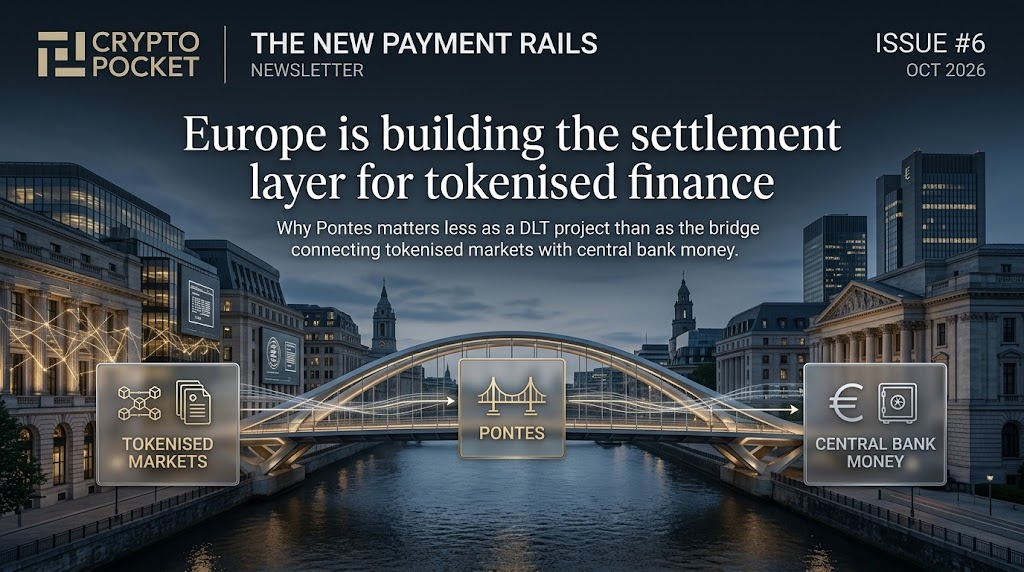
Why Pontes matters less as a DLT project than as the bridge connecting tokenised markets with central bank money.
Financial markets have spent years experimenting with tokenisation.
Securities can be issued on distributed ledgers.
Ownership can move in seconds.
Smart contracts can automate parts of issuance, collateral management, servicing and settlement.
But there is a fundamental problem that often disappears behind the technology.
A financial transaction has two sides.
There is the asset.
And there is the money used to pay for it.
You can tokenise the asset, automate its transfer and make the infrastructure around it significantly faster.
But if the cash leg still depends on disconnected systems, limited operating hours or infrastructure that cannot interact with the tokenised asset, the bottleneck has not disappeared.
It has simply moved.
That is why the launch of Pontes by the Eurosystem deserves more attention than another blockchain pilot.
Pontes is not primarily about creating another digital asset.
It is about connecting tokenised financial markets with something they ultimately need if they are going to operate at institutional scale: central bank money.
Tokenising the asset is only half the transaction
Consider a tokenised bond.
The bond may exist on a distributed ledger.
Its ownership can potentially move almost instantly.
Corporate actions may be automated.
Collateral can be mobilised more efficiently.
But when someone buys that bond, another asset must move in the opposite direction.
Money.
In traditional financial markets, securities settlement relies on infrastructures designed to ensure that the asset and the payment are exchanged safely.
This is the principle behind delivery versus payment:
- 01ASSET — ownership transfer
- 02MONEY — payment
Ideally, both legs settle together.
Tokenisation can significantly improve the asset side of that equation.
But the money side still matters just as much.
The Eurosystem’s own work on DLT settlement reached the same conclusion: market participants identified access to a risk-free settlement asset as critical if tokenised finance is going to scale. Pontes was built directly on the findings of those earlier experiments.
That is the problem Pontes is designed to address.
Europe just connected the two worlds
On 21 September, the Eurosystem launched Pontes.
The name is appropriate.
Pontes means bridges.
Its function is essentially to create one.
Pontes enables wholesale transactions involving tokenised assets to be settled in central bank money, connecting emerging DLT-based markets with Eurosystem settlement infrastructure.
Conceptually:
- 01TOKENISED MARKETS
- 02PONTES
- 03EUROSYSTEM INFRASTRUCTURE
- 04CENTRAL BANK MONEY
This distinction matters.
Pontes is not another blockchain network competing for assets.
It is infrastructure designed to connect tokenised markets with the existing monetary settlement layer.
And the project is already beyond the conceptual stage.
The initial group of participating institutions includes Santander, Deutsche Bank, Société Générale, Cecabank, European Investment Bank, BayernLB, DZ Bank, DekaBank and KfW, alongside market DLT operators including Clearstream, SWIAT, Cashlink and Axiology.
More participants are expected to connect progressively.
The initial service is deliberately limited, with enhanced functionality and longer operating hours planned over time. Full implementation is expected by 2028.
That makes Pontes interesting not because everything changes overnight.
But because a piece of the architecture that institutional tokenisation needs has now moved from experimentation into production.
The Governing Council documentation published on 2 October also confirms that the initial launch is backed by a binding legal framework for a production-grade system, even while this first phase remains transitional.
Why central bank money matters
Why not simply settle everything using another token?
Because large financial markets need more than speed.
They need a settlement asset that participants trust.
Today, central bank money plays that role at the core of the financial system.
Banks may issue deposits.
Private companies may issue other forms of money or settlement assets.
Stablecoins can introduce programmable digital liquidity.
But settlement between financial institutions ultimately benefits from a common monetary anchor.
That becomes particularly important in a tokenised environment.
Without a common settlement layer, the market could develop into:
- 01PLATFORM A — Asset A + Money A
- 02PLATFORM B — Asset B + Money B
- 03PLATFORM C — Asset C + Money C
Each network may work individually.
But together they can create:
- Fragmented liquidity
- Different standards
- Limited interoperability
- Additional reconciliation
- New counterparty dependencies
In other words: digital infrastructure can be fast and still be fragmented.
That is one of the central challenges facing tokenised finance.
The real challenge is interoperability
For several years, much of the digital-asset conversation focused on which blockchain would win.
- Ethereum
- Private DLT networks
- Public chains
- Bank-led networks
- New settlement platforms
But financial markets rarely operate on a single piece of infrastructure.
Banks have systems.
Central banks have systems.
Securities infrastructures have systems.
Stablecoin issuers have networks.
Tokenised deposit projects have platforms.
Fintechs increasingly connect multiple rails.
Corporate treasury teams still need bank accounts, accounting systems, liquidity management and reconciliation.
So the more relevant question may no longer be: Which network wins?
It may be: Which infrastructures can communicate with each other?
The Eurosystem’s broader strategy explicitly places interoperability and the prevention of fragmented financial silos at the centre of the emerging tokenised ecosystem. Pontes addresses the settlement side of that challenge, while Appia looks further ahead at the architecture of a more integrated European digital financial system.
Pontes solves one part of the puzzle.
Appia looks at the bigger one.
This is not simply stablecoins versus banks
The evolution of tokenised finance is often presented as a competition.
Stablecoins versus bank deposits.
Blockchain versus banking infrastructure.
Private money versus central bank money.
The emerging architecture is likely to be more complicated.
Different forms of money can serve different functions.
Central bank money can provide the foundational settlement anchor.
Tokenised bank deposits can extend commercial bank money into programmable environments.
Stablecoins can provide transferable, programmable digital liquidity for particular payment and settlement use cases.
The Eurosystem’s comprehensive payments strategy explicitly contemplates a market in which central bank money remains the anchor for wholesale settlement while private settlement assets — including properly designed and regulated tokenised deposits and stablecoins — can play complementary roles.
That does not mean all instruments are equivalent.
Their risk profiles, regulation, liquidity, reach and use cases differ.
But it does suggest something important.
The future financial system may not be built around a single type of digital money.
It may increasingly depend on the interoperability between several of them.
The competitive layer is moving again
A few years ago, much of the competitive discussion around digital assets focused on the token.
Then attention shifted towards networks.
But as institutional adoption grows, another layer becomes increasingly important: the infrastructure around the transaction.
- 01ASSET
- 02LIQUIDITY
- 03CONVERSION
- 04COMPLIANCE
- 05INTEROPERABILITY
- 06SETTLEMENT
- 07RECONCILIATION
- 08BANKING CONNECTIVITY
These components are much less visible than the token itself.
But for businesses and financial institutions, they are often what determines whether a new rail can actually be used.
This is similar to what we have seen with stablecoins.
Moving a token takes seconds.
Turning that movement into something usable inside a corporate treasury, payment operation or financial institution requires much more infrastructure.
Tokenised securities face the same reality.
The ledger is only one component of the transaction.
What businesses should actually watch
Most companies will not connect directly to Pontes tomorrow.
Pontes is primarily wholesale financial market infrastructure.
But that does not make it irrelevant to businesses.
Financial infrastructure tends to evolve underneath the products companies eventually use.
The internet did not require every company to understand TCP/IP.
Instant payments do not require corporate finance teams to understand every component of the underlying clearing infrastructure.
The same is likely to happen with tokenisation.
Companies may eventually interact with products built on tokenised infrastructure without needing to manage that infrastructure directly.
For CFOs, treasury teams, payment companies and internationally active businesses, there are four developments worth watching.
1. Operating hours
Financial infrastructure is gradually moving towards longer availability.
Pontes is expected to extend its operating hours progressively as the service develops.
For international markets, that matters.
Liquidity does not operate according to a single European working day.
The closer financial infrastructure moves towards continuous availability, the more relevant it becomes for global settlement and treasury.
2. Settlement speed
Faster asset transfer only creates value if the money leg can keep pace.
Reducing the gap between asset movement and payment settlement can reduce counterparty exposure and potentially improve the efficiency with which institutions use liquidity and collateral.
3. Interoperability
The most valuable infrastructure may not be the infrastructure that creates another closed ecosystem.
It may be the infrastructure that connects existing ones.
That applies not only to blockchains, but also to banks, payment systems, tokenised deposits, stablecoins and central bank infrastructure.
4. Reconciliation
Speed is not enough.
A transaction can settle instantly while the operational systems behind it still require hours of manual reconciliation.
The next generation of financial infrastructure will need to improve both: how quickly money moves and how quickly institutions understand exactly what happened.
The invisible infrastructure may matter most
Pontes is unlikely to become a household name.
That is probably a good sign.
Financial infrastructure tends to be most successful when businesses do not have to think about it.
Companies do not want another technology to manage.
They want:
- Faster settlement
- Better liquidity
- Lower operational friction
- Clear compliance
- Reliable reconciliation
- Better connectivity
- Access to money when and where they need it
This is why Pontes matters.
Not because Europe launched another DLT initiative.
But because Europe has started building the connection between tokenised assets and the monetary infrastructure required to settle them.
Tokenisation may change how financial assets are represented.
But representation alone does not create a functioning financial market.
The asset has to move.
The money has to move.
And both sides have to meet.
The New Payment Rails takeaway
Tokenising the asset is only half the transaction.
The next phase of tokenised finance will increasingly be about the infrastructure connecting:
- 01ASSETS
- 02MONEY
- 03LIQUIDITY
- 04INSTITUTIONS
- 05INTEROPERABILITY
- 06SETTLEMENT
- 07RECONCILIATION
Pontes is one of the clearest signals yet that Europe is moving from experimenting with tokenisation to building the infrastructure required to make tokenised markets operational.
And that may ultimately be the more important transition.
The next payment rail needs a settlement layer.
Sources & further reading
- Tokenised finance
- Settlement
- Financial infrastructure