THE NEW PAYMENT RAILS · ISSUE #4
The stablecoin race is moving to the fiat layer
Issuing a token is no longer enough. The next phase of payments will be built around conversion, liquidity, banking connectivity, compliance, settlement and reconciliation.
Yesterday, Circle announced an agreement to acquire Tazapay, a Singapore-based B2B cross-border payments infrastructure company.
The transaction itself is interesting.
But the more important signal is what Circle is buying.
Tazapay brings local payout rails across more than 100 markets, relationships with more than 60 banking and fintech partners, and over $25 billion in annualised payment volume. According to Circle, around 60% of that volume already involves stablecoins. The deal is expected to close in 2027, subject to regulatory approvals.
This is not simply another stablecoin story.
It is another sign that the competitive advantage is moving beyond the stablecoin itself.
Businesses do not buy stablecoins. They buy money movement.
For years, much of the stablecoin conversation has centred around three questions:
Which stablecoin? Which blockchain? Which issuer?
Those questions matter.
But they are rarely the questions a CFO, payment company, marketplace or international business starts with.
They ask:
How do I get money in?
How do I convert it?
How much liquidity is available?
How do I stay compliant?
How does the recipient get local currency?
How do I reconcile everything afterwards?
That changes the way we should think about stablecoin infrastructure.
The token is one part of the payment.
It is not the entire payment.
The missing layer is the fiat infrastructure
A stablecoin can move between wallets in seconds.
But a real business payment begins before the blockchain transaction and continues long after it.
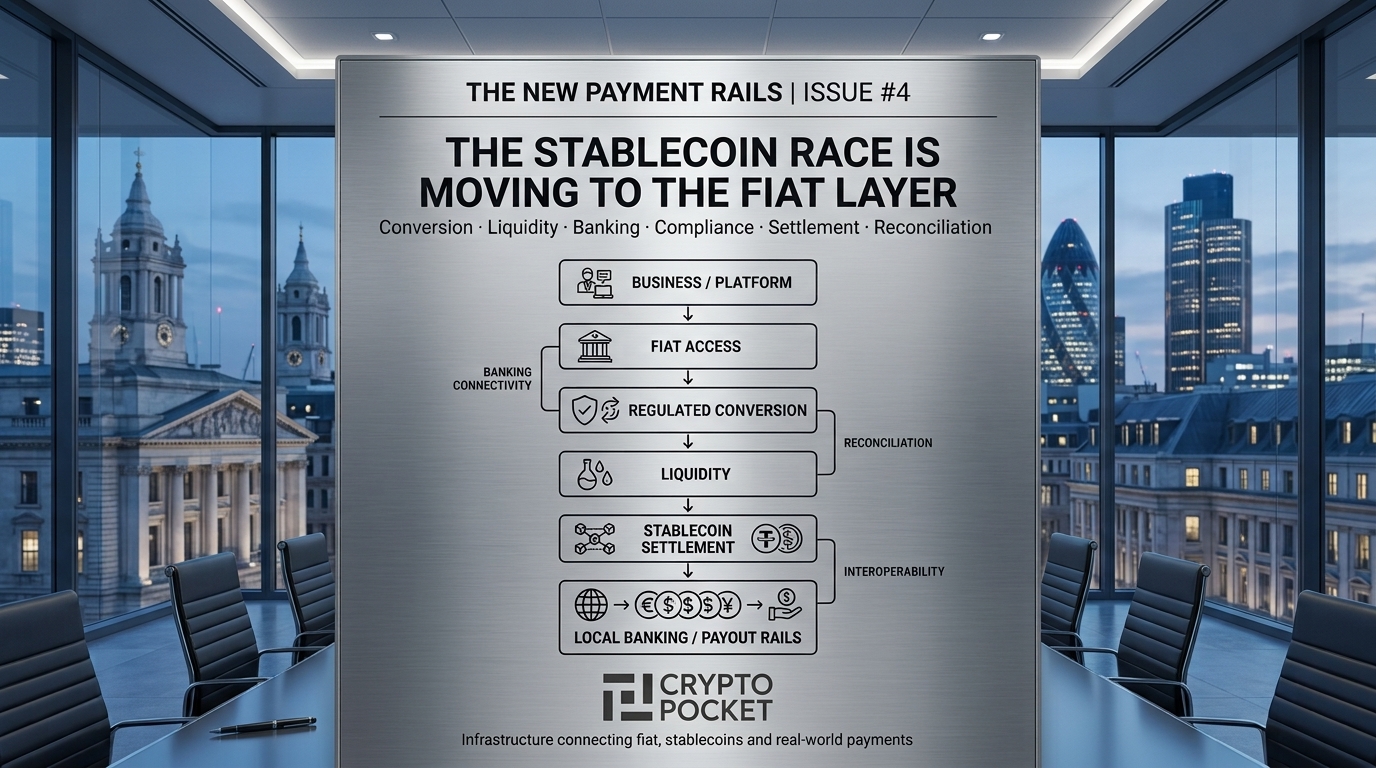
A practical flow looks more like this:
- 01BUSINESS / PLATFORM
- 02FIAT ACCESS
- 03REGULATED CONVERSION
- 04LIQUIDITY
- 05STABLECOIN SETTLEMENT
- 06LOCAL BANKING / PAYOUT RAILS
- 07RECONCILIATION
Every layer matters.
Conversion
Businesses still operate primarily in fiat currencies.
Someone has to connect euros, dollars, pounds and other currencies with stablecoin rails — in both directions.
The easier that conversion becomes, the less businesses need to think about the underlying technology.
Liquidity
Fast settlement means little if liquidity disappears when transaction sizes increase.
For B2B payments, treasury and cross-border flows, liquidity determines whether the economics work at scale.
Compliance
Stablecoins do not remove regulatory obligations.
KYC, KYB, AML controls, transaction monitoring and regulatory reporting remain part of the infrastructure.
In Europe, MiCA makes this particularly important.
Compliance cannot be bolted onto the payment afterwards.
It has to be part of the architecture.
Banking connectivity
This is where the stablecoin narrative sometimes meets reality.
A stablecoin may operate 24/7.
The businesses using it still need bank accounts, local payment rails, beneficiary banks and access to fiat currencies.
Connecting both worlds is therefore more valuable than building either world in isolation.
That is also one of the most revealing elements of the Circle–Tazapay announcement: Circle itself highlights Tazapay's banking relationships and local payout infrastructure as strategic assets.
Settlement
The blockchain leg might settle quickly.
But businesses care about the entire transaction.
When is the money actually available?
When can the supplier use it?
When does the company recognise the payment as complete?
That operational definition of settlement matters more than blockchain speed alone.
Reconciliation
Probably the least glamorous word in payments.
And one of the most important.
A transaction that settles in seconds but takes hours of manual work to reconcile is not necessarily a better payment.
Finance teams need to know what was paid, what was received, which FX rate was applied, which fees were charged and which invoice the transaction belongs to.
Interoperability
The future is unlikely to consist of every company, bank and supplier using the same rail.
Some will use bank deposits.
Some will use instant-payment networks.
Some will use stablecoins.
Some may use tokenised deposits.
The valuable infrastructure will be the infrastructure that allows those systems to work together.
The blockchain transaction can take seconds. Building the payment around it can take months.
Imagine a fintech that wants to add USDC payments.
From the outside, the product requirement sounds straightforward:
Allow customers to pay with stablecoins.
But the operational requirement is very different.
The fintech may need:
fiat access → conversion → liquidity → compliance → stablecoin settlement → local conversion → beneficiary bank account
And behind those arrows sit:
FX.
Banking relationships.
AML controls.
Treasury.
Accounting.
Reconciliation.
Reporting.
Customer support.
Operational risk.
This is why simply adding a wallet or integrating a blockchain does not automatically create a payment product.
Adding stablecoins is becoming easier.
Building the financial infrastructure around them is still difficult.
GLOBAL TRADE LENS
The same logic becomes particularly clear in international trade.
Consider a European importer paying an overseas supplier.
The importer does not wake up thinking:
We need a blockchain strategy.
It wants to know:
How much will the supplier receive?
What will the FX conversion cost?
When will the payment settle?
Can the supplier receive local currency?
How long will capital remain tied up?
Can finance reconcile the transaction automatically?
Will the compliance process work?
Stablecoins can improve part of this workflow by creating another way to move value between markets.
But the stablecoin itself does not solve the complete payment.
The infrastructure around it determines whether the improvement actually reaches the company.
That distinction matters.
Why the Circle–Tazapay deal matters
This is where yesterday's announcement becomes more interesting than the headline.
Tazapay describes its own infrastructure as connecting stablecoin networks with local money, using local currencies and local rails market by market. Its platform includes virtual accounts, conversion, payouts and cross-border payment capabilities.
Circle already has USDC.
What the proposed acquisition adds is more infrastructure around USDC.
More banking connectivity.
More payout markets.
More local rails.
More ability to originate and terminate real-world payments.
That is the signal.
The stablecoin race is increasingly becoming an infrastructure race.
OUR VIEW AT CRYPTOPOCKET
At Cryptopocket, we believe the opportunity is not to turn businesses into crypto companies.
It is to make stablecoin infrastructure usable without requiring businesses to think like crypto companies.
That means connecting traditional money with digital settlement through infrastructure designed around:
fiat ↔ stablecoin conversion
liquidity
compliance
banking connectivity
settlement
reconciliation
For a business, the ideal stablecoin experience may eventually be one in which the stablecoin almost disappears from the experience.
The company sends money.
The supplier receives money.
The treasury team sees the transaction.
Finance reconciles it.
Compliance has the information it needs.
The underlying infrastructure does the rest.
That is when stablecoins stop being a crypto product and start becoming financial infrastructure.
The next competitive advantage
For years, the stablecoin market concentrated heavily on issuance.
The next phase raises a different set of questions.
Who connects stablecoins to bank accounts?
Who provides the liquidity?
Who handles the conversion?
Who connects local payment networks?
Who embeds compliance?
Who manages settlement?
Who makes reconciliation invisible to the business?
Those capabilities will help determine which stablecoin payment products actually scale.
Because increasingly:
Adding stablecoins is easy.
Making them work with the real financial system is where the value is being created.
The New Payment Rails — Issue #4
Analysis published twice a month on stablecoins, payments, regulation and the infrastructure reshaping how money moves.
Sources & further reading
- Fiat infrastructure
- Stablecoins
- Payments