THE NEW PAYMENT RAILS · ISSUE #8
Europe is deciding which stablecoins can become financial infrastructure
Why MiCA’s next phase is about more than licensing — it is beginning to shape liquidity, distribution and the architecture of digital money.
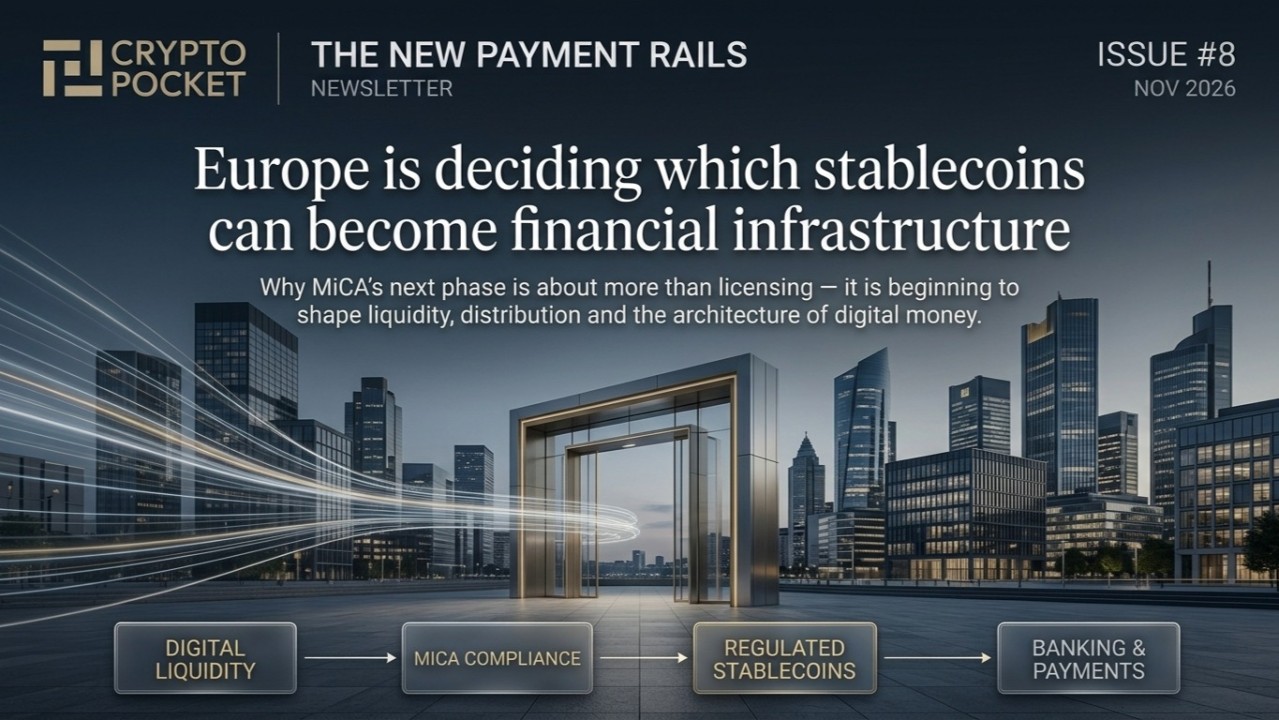
Europe is deciding which stablecoins can become financial infrastructure
Why MiCA’s next phase is about more than licensing — it is beginning to shape liquidity, distribution and the architecture of digital money.
For years, the stablecoin conversation focused on technology.
Which blockchain?
Which token?
Which network was faster or cheaper?
In Europe, another question is becoming increasingly important:
Can this form of digital money actually operate inside regulated financial infrastructure?
Recent developments suggest that this distinction will become fundamental.
ESMA has clarified how authorised crypto-asset service providers should treat stablecoins that do not comply with MiCA.
The European Banking Authority has classified USDC as the first significant e-money token in the European Union.
And Qivalis, backed by 37 European banks across 15 countries, has received regulatory authorisation as an Electronic Money Institution as it prepares to issue a euro-denominated stablecoin.
These are different developments.
But together they point towards the same transition.
Europe is moving from regulating stablecoins as a new category of asset to determining how regulated digital money fits into the financial system.
MiCA is moving from authorisation to market structure
Regulation often appears abstract until it begins changing what market participants can actually offer.
That is now happening.
On 8 October, ESMA published its supervisory expectations for services involving stablecoins that do not comply with MiCA.
Its position is significant.
CASPs authorised under MiCA should cease providing EU clients with services related to non-MiCA-compliant stablecoins.
That applies across a broad range of crypto-asset services, including exchange, execution, transfers, custody and trading platforms.
ESMA also expects appropriate technical, contractual and organisational controls to prevent clients from acquiring or increasing exposure to those assets.
This changes the nature of the regulatory discussion.
MiCA is no longer only determining:
Who can operate?
It is increasingly influencing:
Which assets can move through regulated European infrastructure?
And that has consequences for liquidity.
Compliance is becoming part of liquidity
Liquidity is usually discussed as a market question.
How much volume exists?
How deep is the market?
How easily can an asset be converted?
How many venues support it?
But regulated markets introduce another dimension:
usable liquidity.
A stablecoin can have enormous global trading volume and still become less useful to a regulated European institution if that institution cannot support it across the services its clients require.
The equation therefore begins to change.
Traditionally:
GLOBAL LIQUIDITY
↓
ACCESS
↓
TRANSACTION
Increasingly:
GLOBAL LIQUIDITY
↓
REGULATORY ELIGIBILITY
↓
ACCESS
↓
CONVERSION
↓
TRANSACTION
Compliance is therefore not simply a control applied after liquidity has been found.
It can determine which liquidity is available in the first place.
For payment companies, fintechs and businesses using stablecoins, that distinction matters.
USDC has crossed another regulatory threshold
On 14 October, the European Banking Authority classified USDC, issued in Europe by Circle Internet Financial Europe SAS, as a significant e-money token under MiCA.
There are currently 45 e-money tokens notified under MiCA in the European Union.
USDC is the first to be classified as significant.
From 12 November, it enters the dual supervisory framework established by MiCA for significant EMTs.
The EBA will assume direct supervisory responsibilities in areas including:
own funds
asset reserves
liquidity requirements
recovery plans
redemption plans
while the French ACPR retains responsibility for other supervisory areas.
This does not make USDC risk-free.
Nor does it mean that every stablecoin should be treated in the same way.
It means something more structural.
A globally used dollar stablecoin is entering a deeper layer of European prudential supervision.
That is another indication that stablecoins are moving away from the edges of the financial system.
Europe is also building its own digital euro liquidity
European banks are not standing still.
Qivalis is backed by 37 European banks across 15 countries.
On 14 October, De Nederlandsche Bank granted it authorisation as an Electronic Money Institution.
That makes Qivalis eligible to issue euro-denominated electronic money tokens, subject to the applicable MiCA requirements and publication of the required white paper. Its stablecoin issuance is planned for the coming months.
The strategic rationale matters.
Today, stablecoin markets remain heavily dollar-oriented.
Europe therefore faces two related questions.
How should globally used stablecoins operate within its regulatory framework?
And:
Should Europe develop regulated on-chain euro liquidity of its own?
Qivalis is one answer to the second question.
Its significance is not simply that another stablecoin may enter the market.
It is that dozens of incumbent European banks now consider regulated on-chain money strategically important enough to build shared infrastructure around it.
This is not dollars versus euros
It would be easy to frame this as another currency competition.
Dollar stablecoins versus euro stablecoins.
USDC versus bank-backed digital money.
Stablecoin issuers versus traditional banks.
That misses the more interesting development.
Different forms of digital money are likely to serve different purposes.
Dollar-denominated stablecoins already offer substantial global liquidity and reach.
Euro-denominated stablecoins may become useful for European treasury, settlement and payment flows.
Tokenised bank deposits may serve another set of institutional use cases.
Central bank money remains fundamental to wholesale settlement.
The emerging financial architecture may therefore contain several forms of money simultaneously.
The key competitive layer becomes the infrastructure connecting them.
FIAT
↕
REGULATED STABLECOINS
↕
TOKENISED BANK MONEY
↕
BANKING INFRASTRUCTURE
↕
PAYMENT & SETTLEMENT RAILS
The question becomes less:
Which one replaces everything else?
And more:
Which infrastructure can move efficiently between them?
Stablecoin selection is becoming an infrastructure decision
For a business, choosing a stablecoin can appear simple.
Is it liquid?
Is it fast?
Is it cheap to transfer?
Those questions still matter.
But they are no longer enough.
A company or payment provider increasingly needs to consider:
Who issues it?
Under which regulatory framework?
How does redemption work?
Where are the reserves held?
Which regulated counterparties support it?
What liquidity exists in the required corridor?
Can it connect efficiently with banking infrastructure?
Can it ultimately be converted into the currency the business needs?
The best stablecoin for a transaction is therefore not necessarily the one with the largest global supply.
It is the one that can complete the entire journey.
From regulation to real business infrastructure
At Cryptopocket, this is where the regulatory discussion becomes operational.
As a CASP authorised under MiCA for the exchange of crypto-assets for funds, our activity sits at the point where digital assets and traditional money need to meet.
For a business, moving a stablecoin is rarely the complete problem.
The useful flow is closer to:
BUSINESS
↓
KYC / KYB
↓
COMPLIANT DIGITAL ASSET
↓
LIQUIDITY
↓
REGULATED CONVERSION
↓
FIAT
↓
BANKING SYSTEM
The regulatory status of the asset therefore affects much more than compliance documentation.
It affects whether the infrastructure surrounding the transaction can work reliably.
That is why we believe the next phase of stablecoin adoption in Europe will not be built simply by issuing more tokens.
It will be built by connecting compliant digital money with:
liquidity
conversion
banking
payments
settlement
reconciliation
in a way businesses can actually use.
What businesses should actually watch
Three developments matter particularly closely.
1. Regulatory eligibility
MiCA compliance will increasingly influence which stablecoins regulated providers can support and how they can support them.
For businesses, asset selection becomes a regulatory decision as well as a technical one.
2. Euro-denominated liquidity
A deeper market for regulated euro stablecoins could create new options for European businesses whose underlying treasury and commercial activity is already denominated in euros.
The critical question will be whether sufficient liquidity, distribution and interoperability emerge.
3. Conversion infrastructure
Businesses ultimately operate across currencies.
The most valuable infrastructure may therefore be the layer capable of moving reliably between:
bank money
stablecoins
currencies
payment networks
without forcing the company to redesign its financial operations around the technology.
The New Payment Rails takeaway
Europe’s stablecoin market is entering a different phase.
The first phase was largely about whether stablecoins could work.
The next is about which stablecoins can operate inside regulated financial infrastructure with sufficient liquidity, controls and connectivity to serve real businesses.
MiCA is beginning to influence that answer.
ESMA’s position on non-compliant stablecoins establishes a clear boundary.
USDC’s classification as a significant e-money token shows how a global stablecoin can move deeper into European supervision.
And Qivalis shows that European banks increasingly intend to build regulated digital-money infrastructure of their own.
The result may not be one winning stablecoin.
It may be a financial system in which several forms of regulated digital money coexist — connected by infrastructure capable of converting, settling and reconciling them.
And in that environment:
Compliance is no longer sitting beside liquidity. It is becoming part of liquidity itself.
Sources & further reading
- European Securities and Markets Authority — 8 October 2026 ESMA sets out supervisory expectations on services related to unauthorised stablecoins.
- European Banking Authority — 14 October 2026 The EBA classifies USDC as the first significant e-money token in the European Union.
- Qivalis — 14 October 2026 Qivalis receives authorisation as an Electronic Money Institution from De Nederlandsche Bank.
- Stablecoins
- MiCA
- Payments
- Settlement
Share this edition
Know someone working on payments, treasury or financial infrastructure? Send them this issue.