THE NEW PAYMENT RAILS · ISSUE #2
39 U.S. state bankers associations are building an industry-owned blockchain network. The stablecoin race just changed.
Banks are no longer just experimenting with tokenised money. They are starting to build the infrastructure themselves.
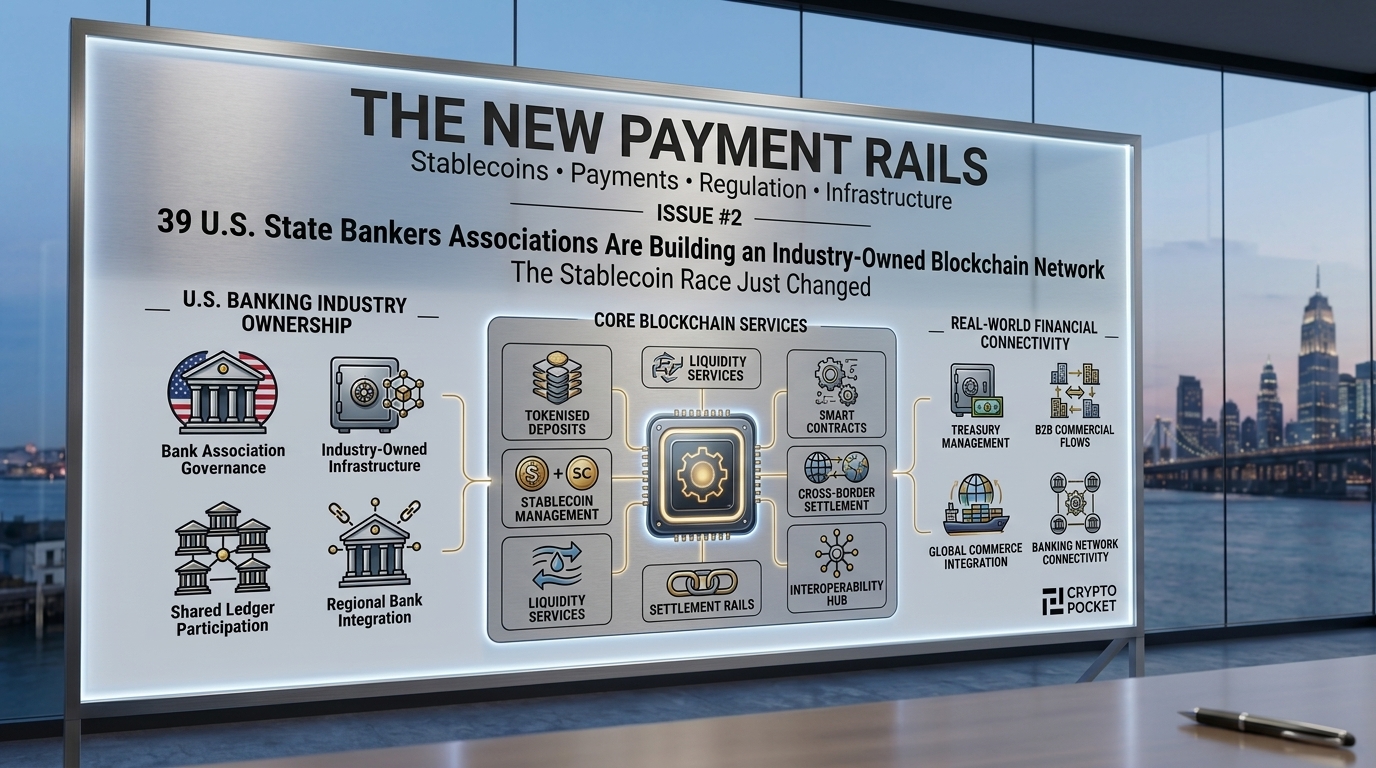
Yesterday, 39 U.S. state bankers associations announced the creation of BankChain Alliance, an industry-owned, industry-designed and industry-governed blockchain network targeting a 2027 launch. The network is intended to support capabilities including smart payments, tokenised deposits, stablecoins and automated settlement.
The associations behind the initiative represent thousands of financial institutions, although BankChain Alliance makes clear that those banks are not individually committed participants unless separately indicated.
That is more important than it may initially sound.
Because the stablecoin debate is moving into a new phase.
The question is no longer simply:
Will banks adopt blockchain?
They already are.
The more interesting question is:
Who will control the infrastructure through which digital money moves?
Banks are moving from users to infrastructure owners
For years, much of the innovation around digital money came from outside the banking system.
Stablecoin issuers built digital dollars.
Crypto companies built wallets and blockchain rails.
Fintechs connected those systems to traditional financial infrastructure.
Banks have spent years experimenting with tokenisation, building proprietary initiatives and partnering with fintech and blockchain infrastructure providers.
BankChain Alliance represents something different: an attempt to build shared infrastructure owned and governed by the banking industry itself.
The banking industry is now considering infrastructure that it can own and govern itself.
The objective is not to create an unregulated alternative financial system.
Quite the opposite.
The alliance explicitly wants participating institutions to offer new digital capabilities while maintaining the regulatory standards, security and trust associated with the banking system.
That changes the competitive landscape.
Because banks are no longer deciding only whether they should integrate stablecoins.
They are also asking whether they should build the rails themselves.
Why tokenised deposits matter
At almost the same time, the Federal Reserve Bank of Dallas published an analysis highlighting why tokenised deposits deserve much more attention.
Tokenised deposits are still bank deposits.
The difference is that they are represented on digital ledgers, potentially enabling faster settlement, programmability and new forms of financial automation.
Unlike stablecoins, they remain directly embedded within the regulated banking framework.
But they also have an important limitation.
A deposit token issued by one bank does not automatically move easily across other banks or networks.
The Dallas Fed identifies this as a central challenge: for tokenised deposits to scale meaningfully, they need to circulate beyond the walls of the issuing institution.
One possible solution?
Consortiums and banking associations.
Which makes the timing of BankChain Alliance particularly interesting.
Stablecoins still solve a different problem
Does this mean banks are about to replace stablecoins?
I don’t think so.
Tokenised deposits and stablecoins overlap, but they are not identical.
Tokenised deposits can be powerful inside banking relationships.
Stablecoins can potentially move across a wider range of:
- blockchain networks;
- wallets;
- fintech platforms;
- marketplaces;
- jurisdictions;
- treasury systems;
- and payment infrastructures.
The Dallas Fed itself notes that tokenised deposits may be less flexible as payment instruments because moving them between issuers is not necessarily straightforward.
That means the future may not be:
bank deposits vs. stablecoins.
It may be an environment in which several forms of digital money coexist.
And once that happens, the strategic problem changes again.
The real race is becoming an infrastructure race
Imagine a global company five years from now.
One bank offers tokenised deposits.
Another counterparty uses a stablecoin.
A supplier wants fiat.
A marketplace settles on-chain.
Treasury still operates through traditional bank accounts.
The company should not need five different operational models to move money between them.
It should simply be able to move value.
That requires infrastructure capable of connecting:
bank money ↔ tokenised deposits ↔ stablecoins ↔ blockchain networks ↔ traditional payment rails
And moving the asset is only one part of the problem.
The infrastructure around it still has to manage:
- identity;
- compliance;
- liquidity;
- conversion;
- settlement;
- reconciliation;
- risk;
- reporting;
- and integration with existing financial systems.
This is why the stablecoin market is increasingly becoming an infrastructure market.
The asset matters.
But the layer connecting the assets may matter even more.
There is another issue banks cannot ignore: liquidity
Tokenisation can make money move faster.
That is good for users.
But faster movement can also change the economics of banking.
The Dallas Fed highlights a potential consequence that gets far less attention than settlement speed.
If deposits can move instantly between institutions, they may become less “sticky”.
Customers could potentially shift balances faster in search of higher yield or better opportunities.
That could force banks to hold more highly liquid assets and change how they manage liquidity.
At sufficient scale, the Dallas Fed argues that tokenised deposits could even influence banks’ traditional role in maturity transformation — using relatively stable deposits to finance longer-term lending.
This is an important reminder:
Faster payments do not remove financial complexity.
Sometimes they move the complexity somewhere else.
Interoperability is becoming the strategic battleground
One week later, 39 U.S. banking associations are announcing plans for an industry-owned blockchain network.
These developments point in the same direction.
Financial institutions are not abandoning the existing system.
They are adding new digital layers to it.
And increasingly, the critical question is how those layers connect.
We are likely to see several infrastructure models emerge:
Bank-owned networks
Stablecoin networks
Card and payment networks
Public blockchains
Fintech infrastructure
Interoperability layers
None of them necessarily has to eliminate the others.
But they will compete to become the infrastructure through which businesses actually move money.
What should businesses and fintechs watch?
I would focus on four things.
1. Who owns the rail?
Infrastructure ownership matters.
A bank-owned network will have different incentives, governance and access rules from an open blockchain or fintech platform.
2. Where does liquidity sit?
Moving between different forms of money requires liquidity.
As more rails emerge, liquidity fragmentation could become as important as technology fragmentation.
3. Can systems communicate?
A brilliant payment rail that only works inside one ecosystem has limited value for a global company.
Interoperability will increasingly determine utility.
4. Can complexity disappear from the user experience?
Businesses do not want a blockchain strategy for every payment.
They want money to move efficiently.
The best infrastructure will probably be the infrastructure that hides most of the complexity underneath.
My takeaway
BankChain Alliance is not proof that banks will defeat stablecoins.
It is proof that banks increasingly understand that the infrastructure underneath money is changing.
And they want a role in building it.
Stablecoin issuers are building.
Banks are building.
Payment networks are building.
Fintechs are building.
The next phase will be about connecting those systems.
At Cryptopocket, we believe this is where the conversation becomes particularly interesting.
The stablecoin race is no longer only a race between digital currencies.
It is becoming a race to build the infrastructure through which digital money actually moves.
And the ultimate winner may not be the rail that replaces everything else.
It may be the infrastructure that makes all those rails work together.
What do you think?
Will banks ultimately build their own closed digital-money ecosystems — or will interoperability force bank money, stablecoins and public blockchain rails to converge?
Sources & further reading
- BankChain Alliance / New Hampshire Bankers Association — announcement of the industry-owned blockchain network and planned 2027 launch.
- Texas Bankers Association — network scope, governance and intended use cases including stablecoins, tokenised deposits and automated settlement.
- Federal Reserve Bank of Dallas — Tokenized deposits could affect bank liquidity, maturity transformation, 25 August 2026.
- Banking
- Stablecoins
- Liquidity