THE NEW PAYMENT RAILS · ISSUE #1
Banks just connected tokenised deposits through Swift. What does that mean for stablecoins?
HSBC, Standard Chartered and Swift have just demonstrated something important: the future of digital money may be less about choosing one rail — and more about connecting them.
On 19 August 2026, Standard Chartered and HSBC announced the first live cross-border interbank transaction using tokenised deposits through Swift’s blockchain-based ledger.
At first glance, this may look like another blockchain milestone.
I think it signals something much bigger.
Because the most interesting part is not simply that two banks used tokenised deposits.
It is how the different layers were connected.
Swift acted as an orchestration layer between the banks’ tokenised-deposit infrastructures. The obligations were coordinated through that shared layer, while final settlement continued through existing financial systems.
That distinction matters.
It suggests that the next phase of financial infrastructure may not require replacing everything that already exists.
It may be about connecting new forms of digital money with the financial rails institutions already trust.
And that changes the stablecoin conversation.
The debate has been framed incorrectly
For years, much of the discussion around digital money has been presented as a competition.
Crypto vs. banks.
Stablecoins vs. deposits.
Blockchain vs. traditional financial infrastructure.
But financial markets rarely evolve through such clean replacements.
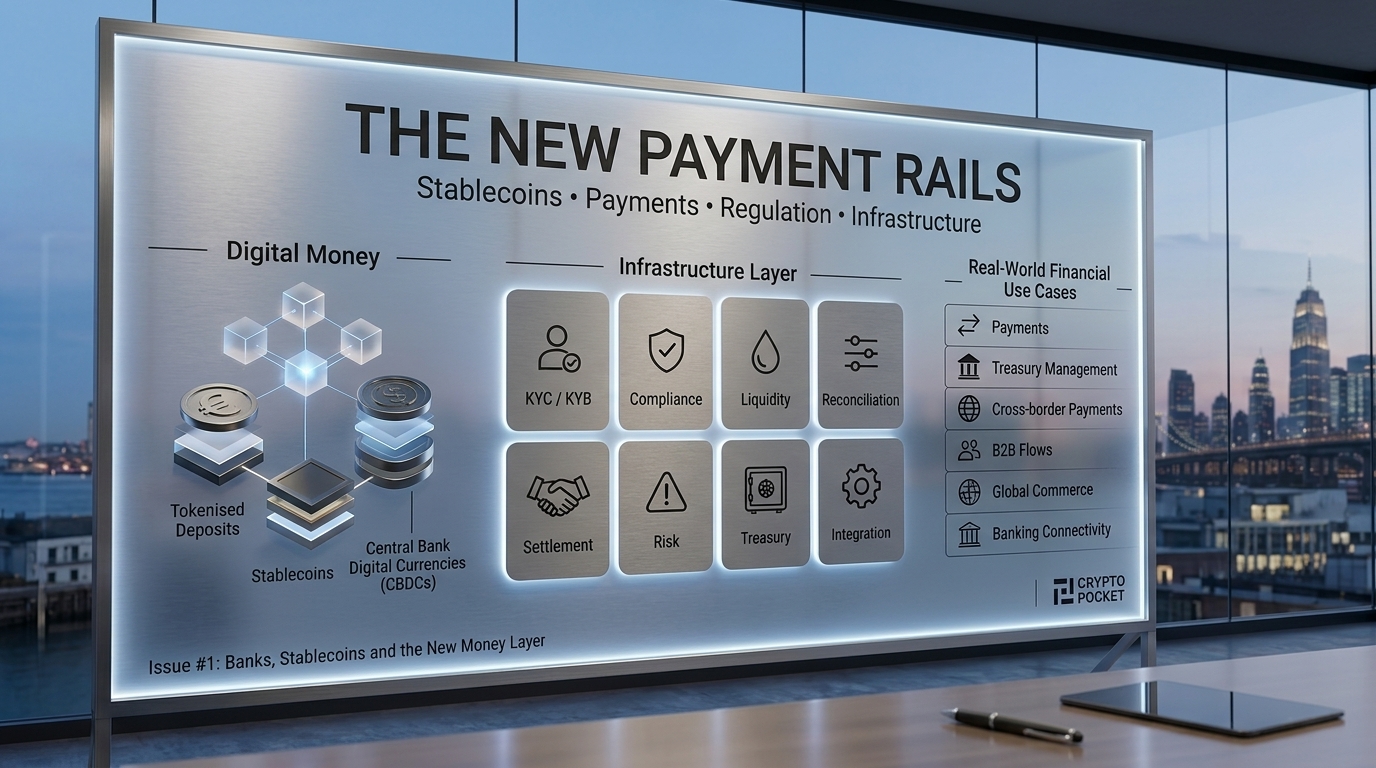
What we are beginning to see instead is the emergence of several different forms of money that may coexist:
Commercial bank deposits
Tokenised deposits
Regulated stablecoins
Central bank money
Traditional payment rails
Blockchain-based settlement networks
The strategic question therefore becomes less about which one eliminates the others.
The real question is:
How will value move between them?
What actually happened?
The HSBC–Standard Chartered transaction gives us an interesting model.
Both banks maintain their own tokenised-deposit infrastructure.
Swift provides a shared blockchain-based orchestration layer that allows separate systems to communicate and coordinate obligations.
The banks do not need to surrender control of their individual infrastructure.
And the existing financial system does not disappear.
Instead, a new layer sits between them.
That layer helps coordinate digital value across institutions.
Swift has also said that 17 banks across six continents are preparing to pilot live tokenised-deposit transactions using this infrastructure, with the objective of supporting 24/7 cross-border payments and improving liquidity efficiency.
This matters because interoperability is becoming one of the central challenges in digital money.
We already know how to tokenise value.
The harder problem is making different forms of tokenised value work together.
Tokenised deposits are coming. Stablecoins are not going away.
It would be easy to interpret the growth of tokenised deposits as banks building an alternative to stablecoins.
That is probably too simplistic.
The two instruments solve overlapping — but not identical — problems.
A tokenised deposit can give a corporate treasurer many of the characteristics already associated with commercial bank money while adding capabilities such as 24/7 movement, programmability and blockchain-based workflows.
Banks can integrate this type of infrastructure into existing relationships with corporate clients, treasury systems and regulated financial processes.
Stablecoins offer something different.
Their potential reach extends beyond a single banking network.
They can move across blockchain ecosystems, wallets, platforms and jurisdictions, making them particularly interesting for areas such as:
- cross-border payments;
- treasury movements;
- digital commerce;
- fintech infrastructure;
- settlement;
- global marketplaces;
- and businesses operating across fragmented banking environments.
So the future may not be:
tokenised deposits OR stablecoins.
It may increasingly be:
tokenised deposits AND stablecoins.
The real race is for the new money layer
This is where the market becomes particularly interesting.
Imagine a company operating globally.
Its treasury may hold commercial bank money.
A supplier may want to receive fiat.
A digital platform may settle in stablecoins.
A bank may offer tokenised deposits.
Another counterparty may operate entirely through traditional payment rails.
From the company’s perspective, those technical distinctions should not be the main concern.
It simply wants to move value efficiently, reliably and compliantly.
That creates demand for an infrastructure layer capable of connecting:
bank money ↔ tokenised deposits ↔ stablecoins ↔ blockchain networks ↔ traditional payment rails
And that layer has to do much more than move tokens.
It must also manage the operational reality around the transaction:
- Identity
- Compliance
- Liquidity
- Conversion
- Risk controls
- Reconciliation
- Settlement
- Reporting
- Integration with existing financial systems
The blockchain transaction may be fast.
The infrastructure around it is where much of the complexity lives.
Interoperability may matter more than the winning asset
The financial industry often searches for winners.
Which stablecoin will dominate?
Which blockchain will win institutional adoption?
Will banks issue their own digital money?
Will tokenised deposits replace stablecoins?
Those are reasonable questions.
But they may be focusing on the wrong layer.
The biggest opportunity may not belong exclusively to the issuer of the winning digital asset.
It may belong to the infrastructure that allows businesses to move between different forms of money without redesigning their financial operations every time a new rail emerges.
That is why the Swift announcement matters.
Swift is not asking banks to abandon the existing financial system.
It is demonstrating an orchestration model that allows new digital-money infrastructure to interact with established financial rails.
That principle could become much broader than tokenised deposits.
What should businesses and fintechs watch now?
There are four areas worth paying particular attention to.
1. Interoperability
Digital-money ecosystems cannot scale indefinitely as isolated networks.
The ability to move value between banks, blockchain networks, stablecoins and tokenised deposits will become increasingly important.
The question is no longer simply whether an institution can tokenise money.
It is whether that money can interact with everything around it.
2. Liquidity
24/7 settlement sounds simple until liquidity also has to be available 24/7.
Moving from banking-hour infrastructure to always-on financial rails changes treasury requirements, liquidity management and operational processes.
This may become one of the most underestimated challenges of institutional digital money.
3. Compliance infrastructure
Moving money faster does not eliminate regulatory obligations.
Identity, transaction monitoring, sanctions controls, AML processes, auditability and risk management still need to operate around the transaction.
Good infrastructure will make those controls work without making the user experience unnecessarily complex.
4. Abstraction
The most successful financial infrastructure usually becomes invisible.
Companies should not need specialist blockchain teams simply to benefit from more efficient payment rails.
Digital money will reach a different level of maturity when businesses can choose the most efficient form of settlement without needing to understand every technical layer underneath it.
The infrastructure can remain complex.
The experience should not.
Europe should pay close attention
This transition is particularly relevant for Europe.
MiCA has created a harmonised regulatory framework for crypto-assets across the European Union, but the market continues to evolve rapidly.
The European Commission is currently reviewing MiCA and gathering views on how the framework should respond to the continued evolution of crypto-assets, stablecoins, tokenised financial assets and related digital-finance services.
That matters because Europe now faces two objectives simultaneously:
Maintain strong regulatory safeguards
and
Remain competitive as new financial infrastructure develops globally.
Those objectives do not have to conflict.
But achieving both will require infrastructure capable of combining innovation with compliance, interoperability and operational resilience.
The competitive question for Europe is therefore not simply whether it regulates digital money effectively.
It is whether businesses and financial institutions can actually build and operate the next generation of payment infrastructure within that framework.
What changes for businesses?
For most companies, the important question will not be whether a payment technically uses a stablecoin, a tokenised deposit or a traditional bank rail.
The questions will be much more practical:
- Can I move funds faster?
- Can I operate across borders more efficiently?
- Can I reduce unnecessary friction?
- Can I access liquidity when I need it?
- Can my compliance processes operate reliably?
- Can I reconcile everything correctly?
- Can the infrastructure integrate with the systems I already use?
Those are ultimately infrastructure questions.
And they are the reason the digital-money debate is moving away from assets alone and towards payments, treasury, settlement and operations.
The bigger picture
Something important is happening across the financial system.
Banks are tokenising deposits.
Stablecoins are increasingly being used in payment and settlement workflows.
Traditional financial networks are incorporating blockchain-based infrastructure.
Fintechs are building new layers between digital assets and existing financial systems.
And businesses increasingly expect money to move globally, continuously and with less friction.
These developments are not necessarily competing. They may be pieces of the same transition.
A transition from financial systems built around isolated rails towards infrastructure capable of connecting different forms of money.
My takeaway
The HSBC–Standard Chartered transaction is not proof that tokenised deposits will replace stablecoins.
And it is certainly not proof that blockchain will replace the banking system.
It may be evidence of something more interesting.
The boundaries between traditional money and digital money are beginning to matter less than the infrastructure connecting them.
The next generation of financial infrastructure will have to connect banks, stablecoins, blockchain networks, liquidity, compliance and traditional payment rails.
At Cryptopocket, we believe this is one of the most important shifts to watch.
The winner may not be one form of digital money.
The real opportunity may be in making different forms of money work together.
What do you think?
Will stablecoins and tokenised bank deposits compete for the same market — or become complementary parts of a new financial infrastructure?
Sources & further reading
- Standard Chartered — HSBC and Standard Chartered live tokenised-deposit transaction through Swift
- Swift — blockchain ledger and tokenised cross-border payments initiative
- HSBC — Tokenised Deposit Service and institutional digital-money infrastructure
- European Commission — current review of the Markets in Crypto-Assets Regulation
- Tokenised deposits
- Interoperability
- Banking