THE NEW PAYMENT RAILS · ISSUE #5
Stablecoins don't need to be the payment
Why real-world adoption begins when digital-asset liquidity can enter traditional business without forcing companies to become crypto businesses.
A property seller does not want a stablecoin.
A real estate developer does not want to manage wallets.
A notary does not need to understand blockchain infrastructure.
They want euros, clear documentation and certainty that the transaction can be completed.
But the buyer may hold part of their wealth in digital assets.
That gap is where infrastructure becomes useful.
For years, much of the conversation around crypto payments focused on whether businesses would eventually start accepting cryptocurrencies directly.
That may have been the wrong question.
The more interesting question is whether digital-asset liquidity can be connected to the traditional economy without forcing the businesses on the other side of the transaction to become crypto businesses themselves.
Increasingly, the answer is yes.
And real estate provides a very good example of what that looks like.
A real-world use case: real estate
This week, Cryptopocket announced a strategic partnership with Blossom Investment Group, the real estate investment and development firm whose partners include footballers Dani Carvajal and Pablo Sarabia, alongside David Rubio and Jorge Simón.
The objective is straightforward.
Some buyers and investors hold part of their wealth in digital assets and want to use that liquidity to acquire property or participate in selected real estate projects.
The property seller, developer or investment vehicle, however, may have no interest in receiving or holding cryptoassets.
They do not need to.
The infrastructure sits in between.
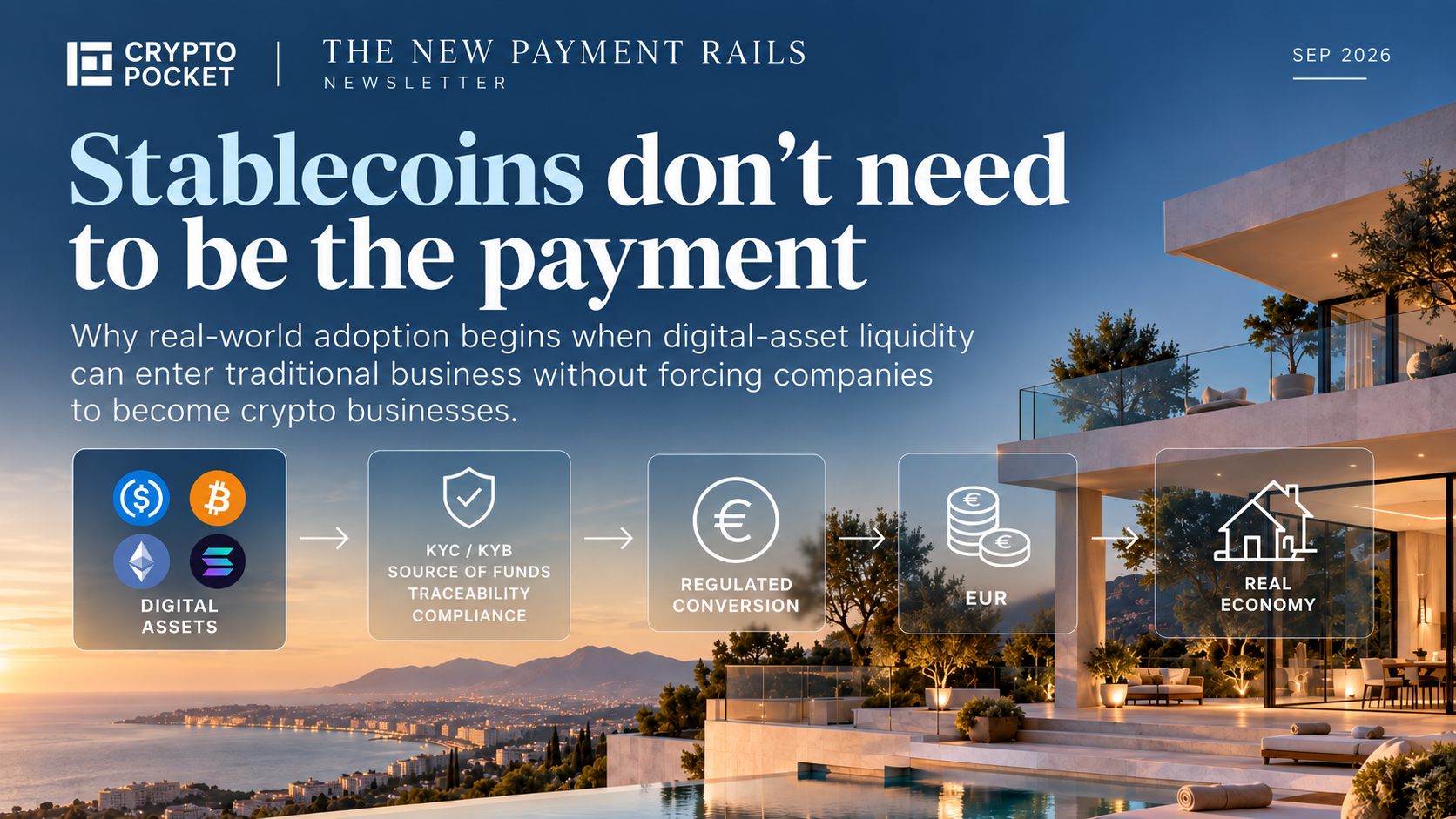
- 01DIGITAL ASSETS
- 02IDENTITY + SOURCE OF FUNDS + ASSET TRACEABILITY
- 03COMPLIANCE + REGULATED CONVERSION
- 04EUR
- 05TRADITIONAL REAL ESTATE TRANSACTION
The digital assets can be converted into euros through Cryptopocket before entering the property transaction.
The seller, developer or corresponding investment vehicle receives euros without needing to custody cryptoassets or assume direct exposure to their volatility.
And importantly, the legal structure of the property transaction does not change.
Contracts remain contracts.
Taxes remain taxes.
Notarial controls and land-registration requirements remain in place.
The technology changes how liquidity reaches the transaction — not the transaction itself.
That distinction matters.
The best infrastructure may be the infrastructure the business never sees
There is a tendency to measure digital-asset adoption by asking how many merchants accept crypto or how many companies hold stablecoins.
But those metrics capture only part of the story.
A business does not necessarily need to hold a stablecoin to benefit from stablecoin infrastructure.
A supplier does not necessarily need a wallet.
A property developer does not need an onchain treasury.
And a CFO does not need to rebuild the company's financial operations around blockchain.
What businesses actually need are outcomes:
- Faster access to liquidity
- Predictable conversion
- Transparent FX
- Reliable settlement
- Traceability
- Compliance
- Reconciliation
Stablecoins and other forms of tokenised money can become part of the infrastructure delivering those outcomes.
That is a very different proposition from asking every company to "adopt crypto".
Real estate is a particularly interesting test
High-value international property transactions expose many of the frictions that exist in today's financial system.
A buyer's wealth may be distributed across:
- Different countries
- Different currencies
- Different banks
- And increasingly, different asset classes
Moving that liquidity into a single transaction can involve several conversions, international transfers, banking cut-off times and extensive source-of-funds documentation.
Digital assets do not magically eliminate those requirements.
Nor should they.
Compliance does not disappear because the asset moves onchain.
If anything, connecting digital wealth with a high-value real-world transaction makes identity, source of funds, transaction history and asset traceability even more important.
The opportunity is therefore not to bypass the existing financial system.
It is to build a better bridge into it.
In the Blossom model, Cryptopocket performs the conversion layer while applying KYC/KYB, AML, sanctions and transaction-monitoring procedures, with additional documentation requested where necessary.
This is where regulation becomes infrastructure rather than simply an obligation.
This is bigger than real estate
Property is one example.
The same architecture can potentially appear anywhere digital liquidity needs to interact with traditional business.
Think about an importer paying an overseas supplier.
A company moving treasury liquidity between jurisdictions.
An international investor entering a traditional asset.
A marketplace settling funds with merchants.
A fintech connecting digital money with local banking rails.
Or a platform that wants to offer stablecoin functionality without rebuilding its entire financial stack.
The end user does not necessarily care which rail moved the value underneath.
They care whether the money arrived.
At the expected value.
At the expected time.
With the documentation required by Finance and Compliance.
And whether it can be reconciled automatically afterwards.
The use case comes first. The rail comes second.
The market is moving in the same direction
This is not happening in isolation.
Capgemini's World Payments Report 2027, published this week, describes a corporate payments market where businesses increasingly want visibility, predictability, liquidity control, embedded compliance and reconciliation — not simply faster movement of money.
Its survey covered 1,110 large companies across nine markets, and Capgemini reports that nearly 60% of corporates would be open to sourcing stablecoin services from non-bank providers. It also projects stablecoins, tokenised deposits and wholesale CBDCs together could represent around 4% of global payment volume by 2030.
Meanwhile, Visa and Reap have just announced an expansion of stablecoin-linked card infrastructure to more than 100 markets, with Reap also settling payment obligations with Visa directly using stablecoins.
In the UK, Barclays, HSBC UK, Lloyds Banking Group, Monzo, Nationwide, NatWest and Santander have completed the first live customer transactions using tokenised sterling deposits on shared infrastructure.
And in Europe, the Eurosystem has launched Pontes, enabling wholesale transactions in tokenised assets to settle in central bank money.
Different instruments.
Different infrastructures.
Different use cases.
But the direction is similar:
Digital money is moving from experimentation towards real financial workflows.
Global trade lens
The same lesson applies to international trade.
An importer does not wake up wanting to use a stablecoin.
It wants to pay a supplier.
A CFO does not necessarily want an onchain treasury.
They want better control over liquidity, FX, settlement and working capital.
The technology becomes relevant when it improves those outcomes without creating another operational silo.
That is why the most important infrastructure around stablecoins may ultimately be everything surrounding the stablecoin itself:
- 01FIAT ACCESS
- 02REGULATED CONVERSION
- 03LIQUIDITY
- 04FX
- 05COMPLIANCE
- 06SETTLEMENT
- 07LOCAL BANKING
- 08RECONCILIATION
The token is one layer.
The business workflow is the product.
Our view at Cryptopocket
We believe the next phase of digital-asset adoption will look very different from the previous one.
Less emphasis on asking businesses to become "crypto companies".
More emphasis on allowing existing businesses to use new financial rails without changing what they are.
A real estate company should remain a real estate company.
An importer should remain an importer.
A marketplace should remain a marketplace.
A bank should remain a bank.
The infrastructure underneath them can change.
That is precisely where we believe regulated conversion infrastructure becomes valuable.
The challenge is not simply moving an asset onchain.
It is connecting that asset with fiat money, banking infrastructure, liquidity, compliance and the real economy.
The partnership between Cryptopocket and Blossom Investment Group is one example of that model in practice.
There will be many others.
The next payment rail may be invisible
The financial infrastructure of the future may contain stablecoins, tokenised deposits, central bank money and traditional bank rails operating alongside one another.
Most businesses will not want to manage that complexity.
And they should not have to.
They will simply want financial infrastructure that is faster, more global, more programmable and easier to operate.
Which leads to a slightly counterintuitive conclusion:
Real-world adoption does not necessarily happen when everyone starts paying in crypto.
It happens when digital assets become useful without everyone needing to know they are using digital-asset infrastructure.
That is when the technology stops being the product.
And starts becoming infrastructure.
The New Payment Rails — Issue #5
Analysis published twice a month on stablecoins, payments, regulation and the infrastructure reshaping how money moves.
Sources & further reading
- Cryptopocket × Blossom Investment Group — Partnership announcement and operating model
- Europa Press — Carvajal y Sarabia se alían con Cryptopocket para canalizar criptoactivos hacia el mercado inmobiliario
- Capgemini Research Institute — World Payments Report 2027
- European Central Bank — Eurosystem brings central bank money to tokenised finance
- UK Finance — UK banks complete first live customer transactions using tokenised sterling deposits
- Reap / Visa — Stablecoin card programs across 100+ markets
- Stablecoins
- Real estate
- Regulated infrastructure