THE NEW PAYMENT RAILS · ISSUE #3
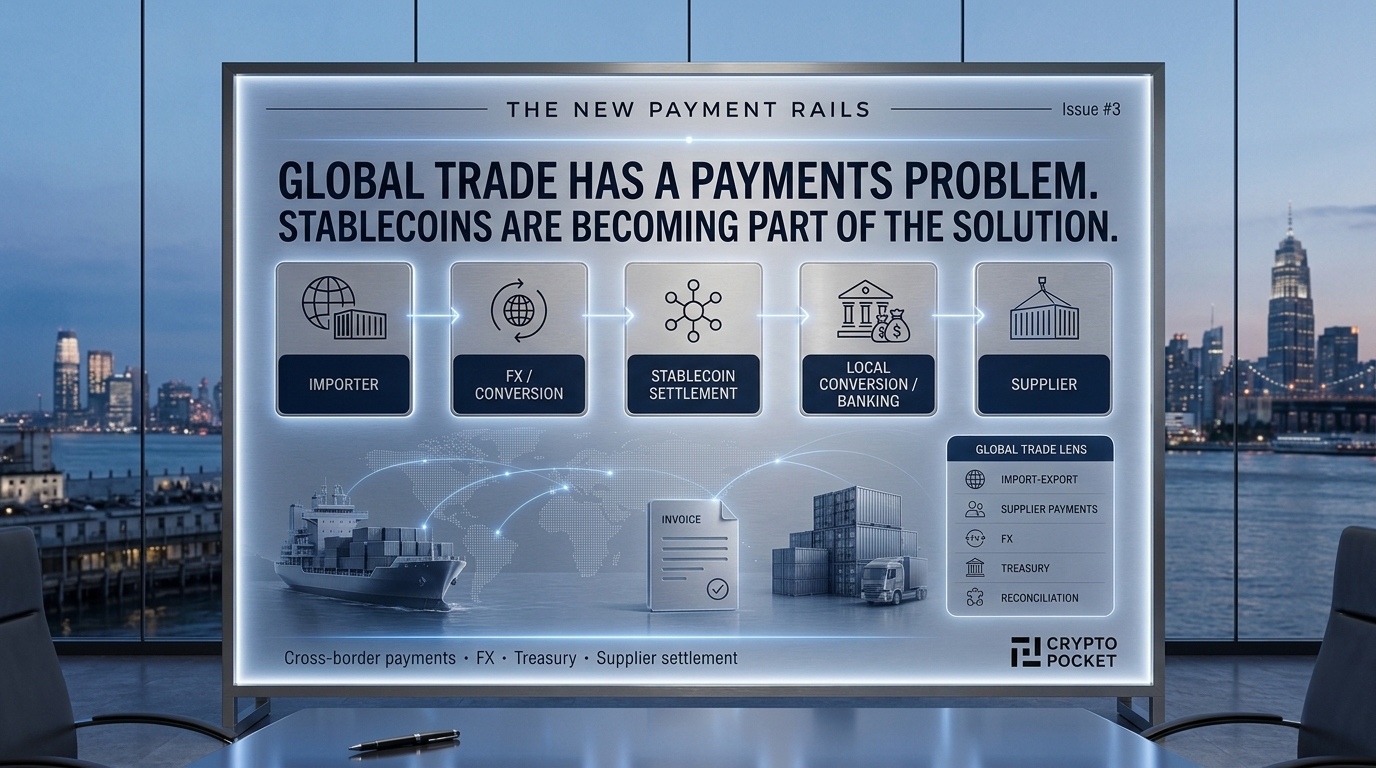
Global trade has a payments problem. Stablecoins are becoming part of the solution.
For importers and exporters, the opportunity is not crypto. It is improving how money moves between currencies, suppliers and markets.
Imagine a European company buying $250,000 of goods from a supplier in Asia.
The commercial transaction may be straightforward.
The payment often is not.
There may be FX to manage, banking cut-off times, intermediary institutions, compliance checks, different currencies, settlement uncertainty and reconciliation once the money arrives.
None of this is new.
What is changing is the infrastructure available to solve it.
Stablecoins are increasingly moving beyond crypto markets and into conversations about corporate treasury, international payments and global trade.
And that is where things get interesting.
Importers do not want crypto. They want better payments.
This distinction matters.
A CFO buying machinery, components or raw materials internationally is unlikely to wake up asking:
“How can we use stablecoins today?”
The questions are much more practical:
How much will the payment cost?
What FX rate will we get?
When will the supplier receive the funds?
Can we settle outside traditional banking hours?
How much liquidity do we need available?
What compliance checks are required?
And how will finance reconcile the transaction afterwards?
That is the lens through which stablecoin infrastructure should be evaluated.
Not as a crypto product. As another financial rail.
Why this conversation is moving into corporate treasury
This week, Standard Chartered published new guidance specifically for corporates and financial institutions, identifying international payments, treasury, liquidity and FX as areas where stablecoins could become relevant.
Treasury Today is asking an equally practical question: beyond crypto markets, can stablecoins become useful for cross-border intercompany and trade payments, including supplier payments? The publication also highlights that corporate usage remains small compared with traditional payment infrastructure — an important reality check.
And in Hong Kong, Standard Chartered is already exploring regulated HKD stablecoin applications spanning treasury management and cross-border trade payments.
That tells us something important:
The conversation is moving from “What are stablecoins?” to “Where can they improve an existing financial workflow?”
Global trade is an obvious place to test that question.
THE IMPORT-EXPORT PAYMENT FLOW
A simplified international supplier payment might look like:
Importer → Bank → FX / payment infrastructure → intermediary or beneficiary bank → Supplier
The exact route varies enormously depending on currency, corridor and banking relationships.
A stablecoin-enabled architecture could introduce another option:
Importer → Regulated conversion infrastructure → Stablecoin settlement → Local conversion / banking infrastructure → Supplier
The supplier does not necessarily need to receive or hold stablecoins.
The importer does not necessarily need to manage wallets or blockchain infrastructure.
The stablecoin can operate inside the settlement layer.
That distinction may prove critical for adoption.
What could actually improve?
Settlement availability. Blockchain-based settlement can operate beyond traditional banking cut-off times.
Cross-border movement. For some corridors, another settlement rail may reduce dependence on long chains of intermediaries.
Treasury visibility. Programmable infrastructure can provide businesses with more immediate information about transaction status.
Operational automation. Payments, conversion and reconciliation can increasingly be connected through APIs rather than treated as separate manual processes.
Supplier experience. If the infrastructure works properly, the supplier should care about receiving the expected amount, in the expected currency, at the expected time — not about the rail underneath.
None of this means stablecoins automatically outperform traditional rails.
It means companies may have another rail to choose from depending on corridor, currency, cost, liquidity and settlement requirements.
A real example from international trade
Codexa is interesting precisely because it was not built as a crypto company.
It is a Brazilian foreign-trade platform integrating areas including customs, freight, FX and international payments for importers and exporters.
It subsequently incorporated USDC settlement alongside traditional payment rails.
According to figures provided by Codexa to Circle, by July 2026 the platform was processing more than $800 million per month, with approximately 20% of settlement volume moving through stablecoins alongside SWIFT flows. Circle notes that it has a commercial relationship with Codexa, so those figures should be understood in that context.
The architecture is what I find most interesting.
Codexa says importers and exporters can use stablecoin settlement without having to manage wallets, blockchain infrastructure, liquidity providers or multiple counterparties themselves.
The technology disappears behind the transaction.
That is much closer to what real adoption could look like.
WHAT THE CFO ACTUALLY CARES ABOUT
For an importer or exporter, success will not be measured in blockchain transactions per second.
It will be measured in:
FX exposure
Settlement certainty
Liquidity
Working capital
Supplier relationships
Compliance
Reconciliation
Operational cost
If new financial infrastructure improves those variables, companies will use it.
If it does not, they will not.
What stablecoins do NOT solve
This is equally important.
Stablecoins do not eliminate FX risk.
An importer funding in EUR and paying a USD invoice still has a currency conversion somewhere in the flow.
They do not eliminate compliance.
They do not automatically guarantee better FX.
They do not remove the need for liquidity.
And if the supplier ultimately wants CNY, BRL, GBP or EUR in a bank account, local conversion and banking infrastructure still matter.
This is why the real opportunity is not simply putting money onchain.
It is connecting stablecoins with FX, liquidity, compliance, banking, settlement and reconciliation infrastructure.
ICC itself now includes the evolution of tools such as stablecoins and ledgers among the digital-asset developments it is monitoring within trade finance.
That is another sign that this conversation is moving much closer to mainstream international trade.
My takeaway
The next phase of stablecoin adoption may look very different from the first.
It may not start with consumers choosing a new way to pay at checkout.
It may happen quietly inside the financial infrastructure used by companies buying and selling goods around the world.
An importer does not need a crypto strategy.
It needs a better way to move money.
Stablecoins become genuinely interesting when they help solve that problem without forcing the company to become a crypto company.
Sources & further reading
- Standard Chartered — Stablecoins: What corporates and FIs need to know, 31 August 2026.
- Treasury Today — Stablecoins are growing but are payment uses?, September 2026.
- Standard Chartered — HKDAP: treasury management and cross-border trade payments, 24 August 2026.
- International Chamber of Commerce — Global Policy Commissions Workplan 2026.
- Circle / Codexa — Codexa brings programmable settlement to international trade with USDC and Circle Mint.
- Global trade
- Cross-border payments
- Treasury